Sunday, January 24, 2010

COOKIE-CUTTER OR FLUFFERNUTTER?

"I always wonder why some people see things as weird and some people don’t." –tim burton

Jacques Henri Lartigue, 1903 Howard Greenberg Gallery

I recently got into a discussion with an artist about individuality versus conformity. Is one better than the other, and aren't they just different sides of the same coin? Without one, the other wouldn't exist. It seems to me that individuality is an illusion; even in freedom of expression there's conformity. Guidelines that are inherent in everything that exists, whether it's a movement, a new school of thought, or a revolution of a social, political, intellectual, or creative bent. We live in a society that functions as a whole, and we're just cogs in the machine. Throw a monkey wrench into it, and the entire system breaks down. Without conformity, society would fall into chaos. Laws, rules, order - these are the parameters in which society remains well-oiled and functioning.


Albert Einstein, Thomas Edison, Salvador Dali, René Magritte

On the flip-side, individuality, and creative and artistic expressions are important. Some make small attempts to break the mold by expressing themselves through dress, interests, or hobbies. Others attempt a rebellious coup d'état, a blitzkrieg of revolutionary ideas that will change how we view the world, and how it views us. People like Copernicus whose idea that the planets revolve around the sun turned everyone's thinking around, Albert Einstein whose offbeat creativity and genius stemmed from his utter disregard for authority, and his refusal to conform. Or Thomas Edison, one of the most prolific inventor, scientist and businessman to live, or the Surrealist movement in the 1920's led by artists like French poet André Breton, and painters René Magritte and Salvador Dali. We owe our progress, discoveries, and breakthroughs to those who had the courage to be different. Sooner or later, most of us cave under the pressure, forced to curb our spontaneous desires to avoid being labeled eccentric or weird, or because we fear being alone. Even as we seek to be different, we all want to belong to something bigger, to be accepted by others. Nothing is as evident of this as modern culture, where there's a tendency to jump on the band-wagon, as a reflection of camaraderie, or the admission price to be a part of a group. From the first moment we are exposed to outside influences, there is a need to be like everyone else. We're taught to follow social norms at home, school, and the work place. To be different is to be dangerous, a loose canon to be watched with a wary suspicious eye.

Modern life is confusing, and sometimes our choices aren't so clear. It may lead us in extreme directions of either conformity or individuality, but like everything else there's a necessity for balance. There's always a chance to make our mark, to march to the beat of another drum. But I think it's more important to stay true to ourselves, and that comes from finding your authentic voice or expression. Ralph Waldo Emerson believed we are creatures of growth and change, responsive to the world around us. And through our experiences, we learn to adapt, come into and breathe new life into ourselves, possibly evolve into someone different. A self-evolution that sometimes contradicts our former selves. But without contradictions, we can never understand the full measure of life.


NOT ALL FLUFF
Fluffernutter sandwich is just about the quintessential American childhood sandwich of days gone by. If you don't know what it is, it's peanut butter and a marshmallow creme spread known as Fluff between two pieces of white bread. It's particularly popular in New England, and Massachusetts even went so far as to propose Fluffernutter as the official state sandwich. For generations, kids grew up with the sticky-sweet, snow-white confection known as Marshmallow Fluff, a product made by Durkee-Mower. Allen Durkee and his partner Fred Mower went into business in 1920, making hard candy and lollipops. They bought the formula for marshmallow cream from Archibald Querry who had been making it in his kitchen and selling it door to door before WWI. He sold the formula - a well-beaten mixture of corn syrup, sugar, dried egg white, and vanillin - to the partners for $500. In the 1940's Durkee-Mower came out with a cookbook of recipes using Marshmallow Fluff as a key ingredient. The peanut butter-and-Fluff sandwich, a customer favorite, didn't take on its Fluffernutter nickname until an ad agency suggested it, and it was registered for trademark in 1961.

It may have been around a good spell, and is undoubtably well-loved to be considered an old standby, but it ain't exactly your standard PB&J. Below is a pie version of the sandwich. Serve with a tall glass of cold milk.


"Ah, Fluffernutters... there are many who say you haven't really lived until you've taken a bite out of one of these distinctly American treats! Long a staple of playgrounds, after-school snacks, college dorms, and the local diner, a Fluffernutter is a wonderful concoction of Marshmallow Fluff and peanut butter in delightfully tasty sandwich!"

Fluffernutter Pie
1 envelope unflavored gelatin
1 cup cold water
3 tbsp sugar
1 tsp vanilla extract
1 cup peanut butter
1 cup Marshmallow Fluff
2 cups heavy or whipping cream
1 Chocolate Crumb Crust (*see below)
  1. In medium saucepan combine 1/2 cup cold water and gelatin; let stand 1 minute.
  2. Cook stirring constantly, until gelatin is completely dissolved. Remove from heat.
  3. Stir in sugar, vanilla and remaining water. Beat in peanut butter and Fluff.
  4. Chill until mixture mounds when dropped from spoon. Fold in whipped cream.
  5. Turn into crust; chill until set.
*Chocolate Crumb Crust
20 Oreos
6 tbsp butter, melted
  1. Crush cookies to fine crumbs and combine with melted butter.
  2. Pour into 9-inch deep-pie pan. Using the back of a spoon, press onto bottom and sides of pan up to one inch of top.

Saturday, January 23, 2010

NATIONAL PIE DAY

Raise your forks, use your fingers, stick your whole face in -
Folks, we got pie!

Today is officially National Pie Day, created by the American Pie Council as part of our American heritage. And nothing says American quite like good ole fashioned pie. Fruit pies, cream pies, custards, meringues, chocolate, and nut pies filled, top-crusted, two-crusted, served with fresh whipped cream, or à la mode - the assortment is varied and endless. This is it, folks, a legitimate excuse to gorge yourself with pie. All you can eat pie!


Set aside today to bake all your favorite pies, or better yet take the opportunity to try a new recipe. Maybe you've been curious about some of the more unusual pies like Seagull Egg Pie, Avocado Pie, or Sawdust Pie. Or old vintage favorites like Vinegar Pie, Funeral Pie, or Shoofly Pie. And standards like apple, pumpkin, or pecan pie. A great way to celebrate the day is to bake and give away pies to friends, neighbors, family, and heck even strangers. Start a new tradition of pie giving, or organize a pie social, an age-old tradition celebrating community by gathering friends and family to share a piece of pie, or to raise funds for worthy causes. Pie socials have been popping up all over the country to raise money for schools, charities, and other organizations. But first and foremost, National Pie Day is a day to eat pies!

U.S.S. North Dakota Bakery crew, Navy Yard, NY 1911

Just to get you started in the interest of pies, here's a how it all got started. The history of pie is rich in flavor, having evolved and adapted itself to changing locales, conditions, and ingredients. Pie eating spans thousands of years, first with the ancient Egyptians, Greeks, and Romans, then to Europe, and eventually to the Americas. The first pies of medieval Europe were called "coffins" or "coffyns", savory meat pies completely enclosed in pastry. Open-crust pastry were known as "traps". These pies held assorted meats and sauce, comparable to our modern casseroles with the pastry crust taking the role of the actual pan. At that time baking containers were limited, and the pastry shell mainly served as a baking dish, storage container, or serving vessel. These thick crusts were made to withstand hours of baking, often making them tough and inedible.


A coffin graces a rich man's table. From Grandes Heures d'Anne de Bretagne, 15th c.

In medieval England, "pie" or "pyes" like its French counterpart "pate" meant bits and pieces of meat baked in pastry, named after the magpie, a bird known for collecting odds and ends. Meat and vegetable pies like shepherd's pie or cottage pie came to North America with the colonists in the 17th century. Eventually their recipes were adapted to the ingredients and techniques available to them in the New World, and the crusts became more tender and flaky, the fillings sweet with fruit and berries. Round and shallow pie pans made their debut to conserve rations. In the 1700's pioneer women often served pies with every meal, cementing the pastry as a unique form of American culture. With food at the heart of gatherings and celebrations, pie quickly moved to the forefront of contests at county fairs, picnics, and other social events. And as settlers moved westward, American regional pies developed introducing new tastes to discerning palettes. Pie recipes both sweet and savory are steeped in cultural and family traditions, and are passed down from one generation to the next.

Konzil von Konstanz (ÖNB 3044, fol. 48v), c. 1465-1475


Now please...
Go eat some pie!

Friday, January 22, 2010

WANDERLUST

"We gotta go and never stop going till we get there."
"Where are we going, man?"
"I don't know but we gotta go."
- On the Road
I admit I have itchy feet. I'm dying to take a trip somewhere, anywhere. Wanderlust is a fever, "an ache for the distance", and I got it bad, real bad.


Here.

Always.

Somewhere else.

Photos by Dennis Stock, published as part of a "Kerouac Road" slide show at Slate.
1) California - The state border at Lake Tahoe, 1968 2) California - "The California Trip", 1968 3) United States - The open road for a motorcycle rider, 1971


On the Road

"My witness is the empty sky." - jack kerouac


"Whither goes thou, America, in thy shiny car in the night?" - jack kerouac


"Everybody was yelling 'Go! Go! Go!'." - jack kerouac


ROAD RASH
Okay, I admit I'm sort of reaching here. But you try matching a pie recipe to a specific topic. This is an old Amish favorite, so named because of the cookie crumbs that bring to mind gravel roads (I could have just made up that last bit.)

Gravel Pie
1 - 9-inch prebaked pie shell
1/2 cup raisins
1 cup brown sugar OR malasses OR honey
1/2 cup hot water
3 eggs, beaten
1 cup cookie or cake crumbs (save some for last)
1/3 cup flour cut with 1/3 cup softened butter
1/2 to 1 tsp cinnamon
1/4 tsp nutmeg
1/8 tsp ginger
  1. Preheat oven to 325° F. Sprinkle raisins into the bottom of the pie shell.
  2. Combine and cook in a double boiler: brown sugar (or molasses or honey), hot water, and eggs. Cool and pour into a pie shell over raisins.
  3. Sprinkle the following alternately over pie: cookie (or cake) crumbs (save some for last), the flour already cut with the butter, cinnamon, nutmeg, and ginger.
  4. Bake 20-30 minutes.

ARTISTS' EXHIBITION

Tonight was the opening of Artists' Exhibition hosted by Community Partners in downtown Los Angeles. The exhibit showcased art from local, regional and national artists like Yoko Kanayama, Trine Wejp-Olsen, and Rodrial Tramell.

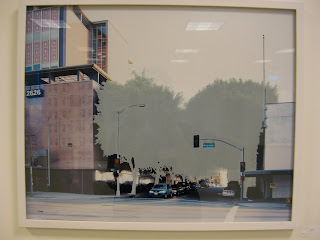
Photographer/Artist Yoko Kanayama's work is a study of Ficus trees in the urban landscape of Los Angeles. She uses mixed media of photographs and silk-screened plexiglass.
"My projects often begin when I notice something mundane and ordinary."
This project began when she decided to photograph a neighbor's Ficus which was scheduled to be cut down because its roots were damaging the water line. She soon started to notice other unusually large Ficus trees throughout the city. In photographing them, she included people to show how extraordinarily large the trees were, and in doing so noticed that the trees seem to take on characteristics of monsters or funny creatures. Because people rarely take note of their surroundings, especially trees, they tended to blend into the mundane urban landscape that included electric wires, graffiti, cars, street signs, etc.

"This reminded me of the English idiom "The Elephant in the Room." In this work I am interested in playing with this idea by making the elephant disappear from the room or make the room invisible around the elephant, in an attempt to make us see the strange phenomena that exist in our surrounding."

Untitled #8 [S. Rampart Blvd. / Beverly Blvd., neg.] 2009 16x20 inch Mixed media


Untitled #5 [N. Vendome St. / Council St., pos.], 2009 16x20
Mixed Media


Untitled #3 [W. Temple St. / N. Dillon St., pos.], 2009 16x20
Mixed media


Untitled #6 [N. Vendome St. / W. Temple St., pos.], 2009 16x20
Mixed media

Kanayama believes people want to devote their lives to something meaningful in order to feel like their lives have purpose. Yet not all of us are meant to be Olympic athletes, or world explorers. However, through the process of creating art she believes artists can have a similar experience of being a world traveler or an athlete without actually going anywhere or being anyone else. And by exhibiting her work, she can share her 'travel experience' with others and communicate with them in a way that doesn't require words.
"We all are different individuals, but by sharing each person's 'travel experience through art', it can make us travel even farther and deeper than our expectations."


Danish born Trine Wejp-Olsen's work intermingles detailed botanicals, animals, and symbolic iconography within dreamlike landscapes. The whimsical paintings and stories Wejp-Olsen tells are kept dynamic with a multitude of narrative elements exploring personal and universal questions. Set in the enchantment of a fairy world, where animals and plants are individually empowered, the paintings reveal an alternate world where there exists a worshipping of nature.

Oh, Butterfly


Yin-Yan Rabbits


The Purple Circus


Trine Wejp-Olsen is represented by Nancy Margolis Gallery in New York, she lives and works in Los Angeles. Her other works, both paintings and sculpture can be viewed on her website.


Rodriel Tramelli's work explores cultural diversity and spirituality through movement and dance. He uses rapidograph ink pens, also known as architectural pens. The images are first drawn in brown ink, then layered over with colored ones.

Untitled, 14x17, Rapidograph Ink


Untitled, 14x17, Rapidograph Ink


Untitled, 14x17, Rapidograph Ink


Community Partners
1000 N. Alameda Street, Suite 24o
Los Angeles, CA 90006
(213) 346-3207

The exhibit is on view by appointment through April 8, 2010.


Thursday, January 21, 2010

BYE BYE BLACK BIRD


"What is drama but life with the dull bits cut out." - alfred hitchcock

The Birds (1963)
"The point is that no-one seemed to be upset about it. They were all gone the next morning just as though nothing at all had happened. Poor things." - The Birds


photographer: erik madigan heck
art director: catharine stuart
clothing: the row ss 2009


4 & 20 BLACKBIRDS
This is one of the oldest nursery rhymes still popular from the "Mother Goose" collections. One of it's earliest printed appearance was in a 1744 song book, however a reference to the poem appears in Shakespeare's Twelfth Night, Act II, Scene III: "Come on; there is sixpence for you: let's have a song." Old European cookbooks dating back to the 16th century did include recipes for baking pies containing live birds as amusement or surprise for dinner guests.


Sing a song of sixpence
A pocket full of rye.
Four and twenty blackbirds,
Baked in a pie.

When the pie was opened,
The birds began to sing:
Wasn't that a dainty dish
To set before the king?

4 & 20 Blackbird Pie (ca. 1598)
TO MAKE PIE THAT THE BIRDS MAY BE ALIVE IN THEM, AND FLIE OUT WHEN IT IS CUT UP (from Giovanni de Roselli's Epulario, or, The Italian Banquet, a translation from Italian into English, London 1598)

Make the coffin of a great Pie or pasty. in the bottome whereof make a hole as big as your fist, or bigger if you will. let the sides of the coffin be some what higher then ordinary Pie, which dome. put is full of flower and bake it, and being baked, open the hole in the bottome and take out the flower. then having a Pie of the bignesse of the hole in the bottome of the coffin aforesaid. you shal put it into the coffin, withall put into the said coffin round about the aforesaid pie as many small live birds as the empty coffin will hold besides the pie aforesaid. And this is to be done at such time as you send the Pie to the table, and set before the guests: where uncovering or cutting up the lid of the great Pie, all the Birds will flie out. which is to the delight and pleasure shew to the company and because they shall not bee altogether mocked, you shall cut open the small pie and in this sort tart you may make many others, the like you may do with a Tart. [via]


Wednesday, January 20, 2010

NO PIE IN THE SKY


photo flickr
"I like too many things and get all confused and hung-up running from one falling star to another till i drop. This is the night, what it does to you. I had nothing to offer anybody except my own confusion." - Jack Kerouac, On the Road

Sometimes life seems to offer too many choices, and at others not enough. When opportunities are confused with distractions, or vice-versa, and the myriad of options leave us in confused despair. What is the balance between order and chaos, method and madness? And how do we navigate the pitfalls from the blessings, the booby traps from the safe havens, and acquire the awareness to distinguish one from the other? When I look back on the places I've been, the dips and turns, the highs and lows, I have few regrets. Rather, I'm grateful for the experiences that shaped my life, the adventures that molded me into the woman I am.

When I was in my teens I longed for something I could not name, that thing just at the tip of the tongue waiting to be sprung, and grasped. I had not lived long enough to know or understand what my heart craved, but longed for anyway. In my 20's I was fearless, chasing after that ever elusive dream with naivete and reckless abandon, determined that for one brief instant I would "catch up, and live for a moment in unison with it", and that would be my miracle. By the time my 30's rolled through, I was somewhat jaded but ever so conscious that each precious moment was to be savored, not swallowed whole like an afterthought. I did not want life to pass me by like a speeding train as if I were staring out the window, the landscape passing quickly like picture-perfect postcards, just beyond my grasp. Each moment is a confession, a declaration of sorts, a promise yet fulfilled.

There are places in the heart that are hollow and echo with the pain of remembrance. And in the spaces in between breathes all the secret longings never voiced. Somewhere, caught in the wind of indecision, is an echo of what has already passed. Many times I have set out with purpose only to be defeated by my own lack of direction or focus. Wanting and choosing are two very different things. We can want and never have that desire fulfilled because we choose not to take the necessary actions to place ourselves closer to that goal. Each decision is a process, or a promise, that must be fulfilled in order to reach its fruition.

Sometimes it seems there is very little we can control in our lives, the topsy-turvy rotation of our days that despite our need for it to slow down, or at times come to a complete stand-still continues on despite ourselves. Spinning off its axis, leaving us dazed and confused, dizzy and crying to be let off. Slowing down, and getting off the merry-go-round takes both courage and infinite patience. You must find your center, an inner balance that won't falter despite the chaos. Only then can you find sure footing, to plant deep the grounding we all yearn for. Many of believe security comes from the very things that cage us, those things that pin us down, and require far more energy and sacrifice to maintain than they should. Status, power, wealth, possessions, all those things that are external expressions, material trappings that in the end are worthless without love, gratitude, and appreciation for the simplicities of life that cost us nothing. Paring down brings an inner serenity that is priceless. Bringing your house in order, taking care of business, crossing off each item on the 'to do' list of life, and the satisfaction that comes with it - these are the things that stuff of dreams are made of. It's the quiet, uncomplicated incidents that bring you happiness, like having the perfect pen to write with, turning on the radio and hearing a song that exquisitely captures the moment, or unexpectedly coming across the very thing you never knew until that moment you were searching for. Life is a series of simple pleasures that give meaning to our time here and now. Living in the present, driven by the power of now. Not caught up in the net of the past, or the phantasm of the future. The only thing that exists is now, everything else is an illusion that was never in our grasp to have or to hold. When the present fades into the past, nothing but a faint recollection distorted by the folding and refolding of our lives it can offer you little but regret. But nothing is as exhausting as the grasping for tomorrow, for that thing which has yet to happen. It is but a taunting apparition, a yearning or a bogeyman, steeped in hope or shrouded in darkness. For every step backwards, and every blind leap forward, we've already lost right now, tripping in our haste to leave today behind and jump into tomorrow. Now is the breath of life, without now there would be nothing but yesterdays and tomorrows. Without now, instead of memories we live with regret, and instead of possibilities we grasp at nothing. Today should be savored, chewed to the fullest, and swallowed like it's our last meal.

Neil Cassady and Jack Kerouac
"The only people for me are the mad ones, the ones who are mad to live, mad to talk, mad to be saved, desirous of everything at the same time, the ones who never yawn or say a commonplace thing, but burn burn burn, like fabulous yellow roman candles exploding like spiders across the stars and in the middle you see the blue centerlight pop and everybody goes "Awww!" - Jack Kerouac, On the Road
CAUSE LIFE IS DANG GOOD PIE
This is a scrumptious vintage pineapple coconut pie, otherwise known as Dang Good Pie. Best served with a scoop of optimism, and a zest for life.


Dang Good Pie
1 large or 2 small prepared pie shells
1 stick butter, softened
2 tbsp flour
1 can (8.25-oz) crushed pineapple, drained
2 1/4 cups sugar
1 tsp vanilla extract
1 can (3.5-oz) Angel Flake coconut
dash of salt
6 eggs
  1. Preheat oven to 350° F. Beat eggs. Add flour, sugar, and butter. Mix well.
  2. Add pineapple and the rest of the ingredients, mixing well.
  3. Baste the pie shell(s) with beaten egg white to prevent a soggy crust. Pour pineapple cocount filling into pie shell(s).
  4. Bake for 45 minutes, or until set and browned. Cool pie completely, and refrigerate. Best served chilled.